
Pai Gow Tiles Rankings
Pai Gow Tiles uses 32 Chinese domino-style tiles to create two separate two-tile hands. Unlike games in which the highest numerical total always wins, Pai Gow Tiles includes a traditional hierarchy of pairs and special combinations. Some hands outrank others regardless of their pip count.
Learning the rankings is one of the most challenging - and rewarding - parts of the game. Understanding the Pai Gow tiles ranking order makes it easier to compare pairs, Wongs, Gongs, and numerical hands with the Banker's corresponding hands.
Key Takeaways
- Pai Gow Tiles uses 32 tiles arranged into 16 recognized pairs.
- Wongs rank below pairs but above Gongs, while Gongs rank above ordinary numerical hands.
- To win the wager, both of the player's hands must beat the corresponding Banker's hands.
- If the player wins one hand and the Banker wins the other, the result is a push.
- The Banker wins tied hands.
Understanding the 32 Pai Gow Tiles
The Pai Gow Tiles set contains 32 tiles. These tiles form 16 recognized pairs: 11 matched pairs made from identical tiles and five mixed pairs made from tiles with equal totals but different pip arrangements.
Each tile displays between two and 12 pips. Although the markings resemble dominoes, Pai Gow Tiles does not rank tiles by numerical value. In the Pai Gow tiles ranking system, traditional names and symbolic rankings determine the strength of the pairs.
Under the Pai Gow Tiles rules, each player and the Banker receive four tiles at the beginning of a round. Those four tiles must be divided into two hands:
- A high hand, sometimes called the back hand
- A low hand, sometimes called the front hand
Each hand contains two tiles. The high hand must rank above the low hand. If the hands are not set properly, the dealer may treat them as a fouled hand under the rules of play.
The goal is to make both of your hands stronger than the Banker's corresponding hands. Understanding the complete ranking order helps you decide whether to keep a strong combination together or divide your tiles to create two competitive hands.
Pai Gow Tiles Ranking Chart
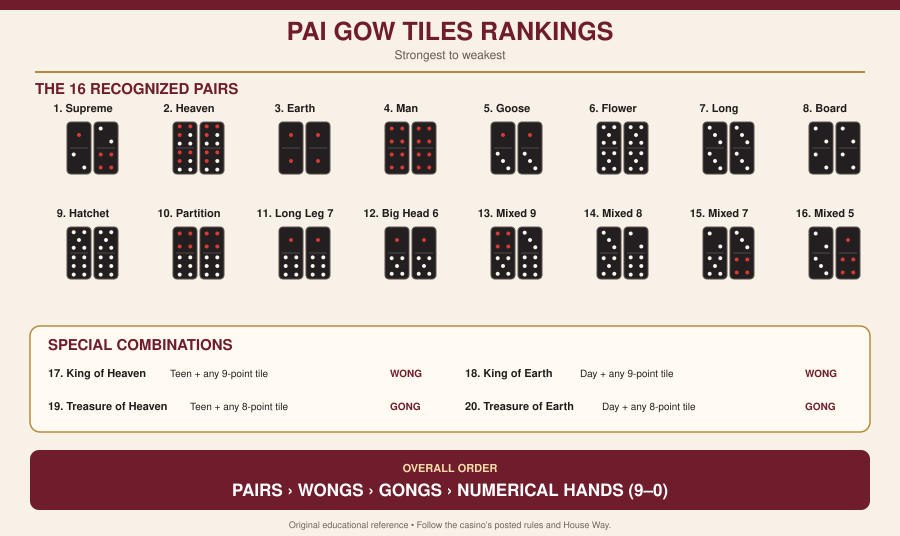
Pai Gow Tiles hands fall into four broad categories. From strongest to weakest, the order is:
1. Pairs- 2. Wongs
- 3. Gongs
- 4. Numerical hands from 9 through 0
Within the pair category, the 16 recognized pairs have their own fixed ranking. A pair's strength is based on its traditional position in the hierarchy rather than the total number of pips.
Supreme and the Ranked Pairs
The Gee Joon pair is the highest possible two-tile hand. It consists of the 1-2 tile and the 2-4 tile. Although these tiles do not match visually, together they form the Supreme Pair and outrank every other pair.
The other 15 pairs follow in a fixed sequence beginning with Teen (or Heaven) and Day (or Earth). A pair always outranks a Wong, Gong, or numerical hand, regardless of how many pips appear on the tiles.
When comparing two pairs, the pair higher on the Pai Gow tiles ranking chart wins. For example, a Yun pair ranks above a Mooy pair even though the Mooy tiles have a larger numerical total.
A pair must consist of the exact recognized combination. Two tiles with the same total do not necessarily make a pair. For example, an individual 4-4 Yun tile and a mixed eight tile do not form a pair simply because both contain eight pips.
Wongs: King of Heaven and King of Earth
A Wong combines a Teen or Day tile with any nine-point tile.
The two Wong categories are:
- King of Heaven: A Teen tile, or 6-6, combined with a nine-point tile
- King of Earth: A Day tile, or 1-1, combined with a nine-point tile
The King of Heaven is the stronger of the two Wongs. Both Wongs rank below all recognized pairs but above every Gong and numerical hand.
A Wong is sometimes described as worth 11. That does not mean it is scored like an ordinary 11-point hand. It is a special combination with its own place in the hierarchy.
Gongs: Treasure of Heaven and Treasure of Earth
A Gong combines a Teen or Day tile with any eight-point tile.
The two Gong categories are:
- Treasure of Heaven: A Teen tile, or 6-6, combined with an eight-point tile
- Treasure of Earth: A Day tile, or 1-1, combined with an eight-point tile
In the Pai Gow tiles rankings, the Treasure of Heaven outranks the Treasure of Earth. Both Gongs rank below Wongs but above all ordinary numerical hands.
A Gong is sometimes described as worth 10. Like a Wong, however, it is treated as a special ranked combination rather than an ordinary point total.
The hierarchy of these special hands is therefore:
- 1. King of Heaven
- 2. King of Earth
- 3. Treasure of Heaven
- 4. Treasure of Earth
Numerical Values and Symbolic Rankings
If a hand does not contain a pair, Wong, or Gong, its value is calculated by adding the pips on the two tiles. If the total is 10 or greater, drop the tens digit and use only the final digit.
For example:
- A 10-point tile and a nine-point tile total 19, creating a nine-point hand.
- An eight-point tile and a six-point tile total 14, creating a four-point hand.
- Two 10-point tiles total 20, creating a zero-point hand.
Nine is the strongest ordinary numerical hand, and zero is the weakest. This scoring method is sometimes compared with baccarat because only the final digit determines the point value.
The Gee Joon tiles are an important exception. When they are separated rather than played together as the Supreme Pair, either Gee Joon tile may count as 3 or 6, whichever creates the stronger hand.
For example, a Gee Joon tile combined with an 11-point tile could produce:
- 3 + 11 = 14, for a four-point hand
- 6 + 11 = 17, for a seven-point hand
Traditional Pai Gow tiles rankings also account for individual tile rank when two numerical hands have the same point value. The hand containing the highest-ranked individual tile generally wins the comparison. If both hands have the same numerical value and the same highest-ranking tile, the Banker wins the tie. The lower-ranked tile is not normally used as an additional tiebreaker.
Pip colors do not determine the outcome. They help distinguish the traditional tile patterns, but the hand's category, point value, and highest-ranked tile control the comparison.
Comparing the Player's and Banker's Two Hands
After receiving four tiles, the player divides them into a high hand and a low hand. The Banker does the same, typically following the casino's established house way.
The player's high hand is compared only with the Banker's high hand. The two low hands are then compared separately. A powerful high hand cannot compensate for a low hand that loses; both comparisons affect the result.
Winning
The player wins when both player hands beat the corresponding Banker hands.
For example:
- The player's high hand beats the Banker's high hand.
- The player's low hand also beats the Banker's low hand.
If you receive a recognized pair, Wong, or Gong, you must still decide how using that combination will affect your other hand. Keeping the strongest possible high hand is not always the best arrangement if it leaves you with a low hand that has little chance of winning.
Losing
The player loses when both Banker hands beat the corresponding player hands.
The wager also loses when one player hand loses and the other ties, because the Banker wins tied comparisons. If both hands tie, the Banker wins both hands, and the player loses the wager.
A hand may also lose if the player sets the tiles incorrectly, such as arranging the designated low hand above the high hand. If the Pai Gow tiles ranking order is unfamiliar, ask the dealer to clarify the rules before play continues.
Push
The round is a push when the player wins one comparison, and the Banker wins the other.
For example, the player may have the stronger high hand while the Banker has the stronger low hand. In that situation, neither side wins both hands, and the original wager is returned.
Pushes are common in Pai Gow Tiles. The possibility of dividing a strong set of four tiles in different ways adds much of the game's strategy. Players are often trying not only to create the strongest possible hand, but to balance both hands well enough to win twice - or at least avoid losing both comparisons.
Play Pai Gow Tiles at Cache Creek
Visit Cache Creek Casino Resort to put your knowledge of Pai Gow Tiles rankings into practice. Study the pair hierarchy, watch how Wongs and Gongs are formed, and ask one of our dealers for help if you are still learning how to arrange your tiles. Understanding the rankings takes time, but each round offers another opportunity to become more familiar with the game.Explore our table games, then make more of your trip with our AAA Four Diamond hotel, resort dining, spa, pools, golf, and live entertainment. Visit us at Cache Creek Casino Resort today to try your luck at the tables and enjoy a luxurious stay!